College Interviews: Which Colleges Offer Them—and How Should You Prepare?
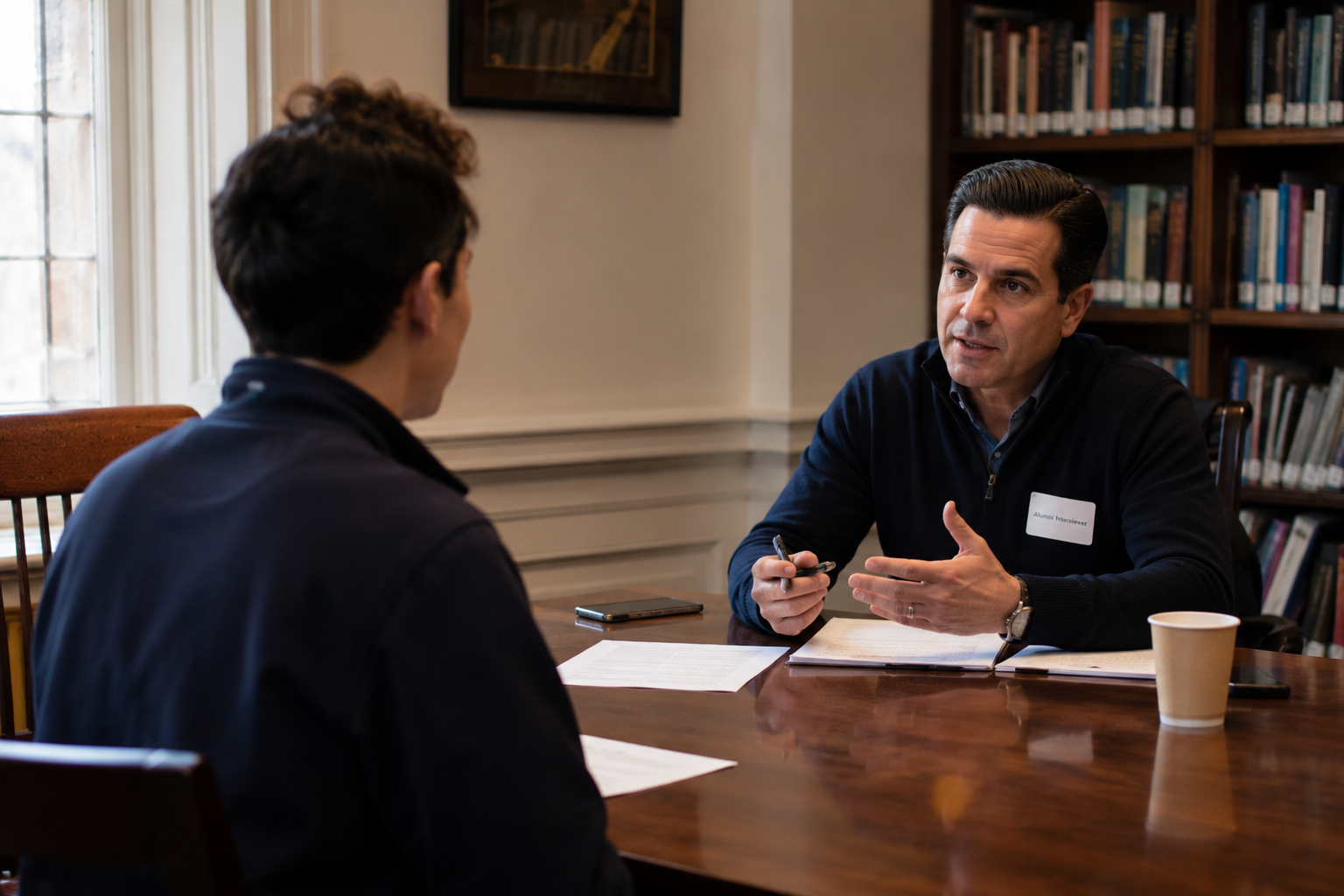
Not every college interviews applicants, and among those that do, an interview means something different from school to school. Knowing which kind you're walking into changes how you should prepare for it — and it's worth knowing well before you need it, since several schools begin assigning interviewers before the calendar year is out, well ahead of when decisions are released.
What the interview is actually for. Your file is built from documents — grades, scores, essays, a list of activities. None of them talk back. The interview is the one part of the process where an actual person gets to see how you think on your feet: what you get excited about, how you talk about a setback instead of just writing about one, whether the person in the room matches the person on paper. For evaluative interviews, that read becomes part of your file. For informational ones, the stakes flip — schools like Cornell say so outright, telling applicants there's "no need to be nervous" because nothing from the conversation goes back into the file. Same kind of conversation, genuinely different purpose: one is partly about being assessed, the other is mostly about you getting a real feel for the place.
The two categories. An evaluative interview becomes part of your file — your interviewer submits a written report, and an admissions committee reads it alongside the rest of your application. An informational interview exists for your benefit: a chance to ask questions and get a feel for the school, with no report going back to admissions. Some schools blend the two, and colleges aren't always upfront about which one you're getting. Your safest approach is to treat every interview as if it counts, because in practice, most of them do to some degree.
Georgetown is the clearest evaluative case. Every first-year applicant is required to complete an alumni interview, waived only when no interviewer is available in your geographic region — and Georgetown says plainly that not having an interview never counts against your application. The program runs through more than 7,800 alumni volunteers across all fifty states and dozens of countries.
Yale, Dartmouth, and Princeton are evaluative, but limited by availability. Yale describes its own interviews as evaluative across the board — reports go into your file alongside the rest of your application — but only a limited number of applicants are invited at all, prioritized toward students the committee wants more information about. If you aren't invited, that's not a signal either way. Dartmouth uses almost identical language: alumni interviews are both informational and evaluative, and a report is added to your file, but Dartmouth can't offer one to every applicant due to alumni availability. Princeton's alumni interview program is sometimes referred to as Positively Princeton, and its own admissions site frames the conversation as informal and ambassador-like rather than a formal evaluation — but the same site confirms interviewer comments are included in the review of your application and may inform the committee's decision, even as Princeton can't guarantee you'll be matched with an interviewer.
Harvard and MIT run less broadly than their reputations suggest. Harvard's own admissions site describes interviews as something that happens when the committee wants more information beyond what's already in your application — not something offered as a matter of course to most applicants, and not something you can request. In most cases, Harvard says, the file already has enough information to decide without one. MIT is similarly direct: an interview with a volunteer Educational Counselor is not a required part of the application, and with just over 3,500 ECs worldwide, MIT can't guarantee you'll get one. MIT has published that interviewed applicants are admitted at meaningfully higher rates than those who weren't offered an interview — though the school attributes part of that gap to self-selection among stronger applicants, not the interview alone deciding outcomes.
Cornell is genuinely informational. Cornell's own admissions blog is direct about it: alumni contacts are "informational, not evaluative — no need to be nervous." The school doesn't offer what it calls "a true interview" at all, specifically to keep the process as equitable as possible across applicants. Nothing from the conversation feeds back into your admissions file the way it does at Georgetown or Yale.
Where there's no interview at all. Many of the largest public universities don't offer interviews to general applicants — the volume makes it logistically impractical. If a school isn't listed as offering interviews on its admissions site, it's safe to assume one won't be part of your process there.
How to turn it to your advantage. Your alumni interviewer typically hasn't seen the rest of your application — MIT says this explicitly about its own process, and it's the norm at most schools that use outside alumni volunteers rather than admissions staff: no essays, no transcript, no activities list in front of the interviewer. That's not a gap to fill by summarizing your resume; it's your one chance to say, out loud, the things your written materials didn't have room for. Three things separate an interview that helps from one that's forgettable:
Bring specific questions, not general ones. "What's the workload like?" gets a generic answer. A question built from something you actually found on the department's own page or a recent piece of school news gets a real conversation, and it signals you've looked into the school rather than added it to a list.
Answer the question that was actually asked, not the one you rehearsed for. Interviewers can tell when a response is a prepared monologue arriving on cue. A stronger habit: pause, actually consider the specific question, and let the answer be a little unpolished. A slightly imperfect real answer reads as more genuine than a smooth one that doesn't quite fit what was asked.
Follow up. A short thank-you note referencing something specific from the conversation — not "thank you for your time," but "thank you for the story about the a cappella audition, it made me even more excited about X" — costs five minutes and is one of the few parts of this process still genuinely rare enough to stand out.
And because several schools blend the two categories in practice, walking in prepared as if it's evaluative costs you nothing, even at a school that describes its interviews as purely informational.
The strongest interviews aren't the product of a good week of prep. A student who can talk fluently and specifically about a real interest didn't learn to do that the night before — that fluency comes from actually having spent years on the thing they're talking about. That's the real reason Ivy Link works with students well before senior year: not to coach a convincing answer on the spot, but so that by the time you're in that room, you're speaking with the full credibility of everything you've actually built, and the quiet confidence of knowing who you've grown into along the way. If you want a profile evaluation and advising built around that, whether your interviews are coming up this fall or you're years out from them, contact Ivy Link today.