Brown Class of 2030 Early Decision Results: What the Numbers Actually Tell You

If you applied to Brown Early Decision this year—or you’re thinking seriously about it—you’re probably looking at one number and asking the only question that really matters:
What does this mean for me?
Brown released decisions two days later than planned after a tragic act of violence on campus. The university’s message was brief and clear: care for the community first, then clarity for applicants. That response is consistent with how Brown tends to operate—measured, values-forward, and deliberate.
That context matters. Now, the numbers.
The Basics
For the Class of 2030, Brown:
received 5,406 Early Decision applications
admitted 890 students
resulting in an Early Decision acceptance rate of approximately 16.5%
Unlike some peer institutions, Brown does not publish Early Decision denial or deferral rates. The data released is intentionally high-level: total applications, total admits, and the resulting percentage.
That means any useful interpretation has to focus on what Brown chose to disclose—and what that information can reliably tell us.
The Pattern That Matters More Than the Percentage
Across multiple Early Decision cycles, one institutional behavior has remained remarkably consistent:
Brown admits roughly the same number of students Early Decision each year—regardless of how many students apply.
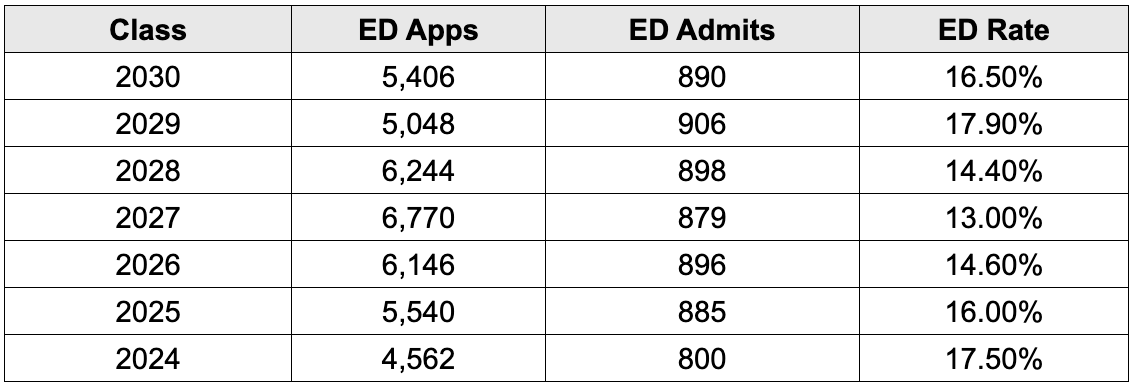
Application volume moves. Early Decision capacity stays largely fixed. That distinction is often overlooked—but it’s the one that matters.
Why These Numbers Likely Look the Way They Do
Early Decision at highly selective institutions is rarely about reacting to demand. It’s about managing certainty.
A stable ED admit range usually reflects three realities:
First, Early Decision is a certainty tool.
It allows the institution to lock in a predictable portion of the class early. That matters for yield and long-term class construction—not for signaling generosity.
Second, holding ED admits steady preserves flexibility.
By not expanding Early Decision offers in high-volume years, Brown maintains room in Regular Decision to balance academic interests, learning styles, and institutional priorities across the full applicant pool.
Third, the evaluation bar doesn’t move just because the pool does.
When fewer students apply, acceptance rates rise even if standards are unchanged. When more apply, rates fall—even if the bar is exactly the same.
Put simply: the percentage reflects applicant behavior; the admit count reflects institutional intent.
What This Means for You
It’s easy to read a higher or lower acceptance rate and assume it says something about your chances. But given how consistently Brown allocates its Early Decision seats, the more important question is different.
The real question isn’t how competitive this year looked on paper—it’s whether your application meets Brown’s standard in the ways that actually matter.
At this level, once academic readiness is established, decisions are driven by differentiation: clarity of intellectual direction, depth of engagement, momentum over time, and whether your story reads as specific and real—not generic or well-packaged.
Strong numbers are assumed. What separates applicants is substance.
How Strong Applications Are Built Over Time
At Ivy Link, this is how Early Decision strategy is evaluated: by looking at fit, constraints, and priorities—then pressure-testing whether an application is ready before a student commits.
That’s also why we work with families early—often beginning in middle school. Not to rush the process, but to give students time to develop real substance. We help students identify genuine interests, deepen them thoughtfully, and turn that growth into measurable accomplishments that add up to a coherent, authentic profile.
When grades and scores stop differentiating, clarity, depth, and consistency do. And those qualities don’t appear at the last minute—they’re built over years.
How to Think About Your Own Application
If Brown is on your list and you’re considering Early Decision, a competitive application typically shows:
Academic readiness for a rigorous, discussion-driven classroom
Depth of engagement with visible, measurable outcomes—not just participation
Narrative coherence: a clear throughline connecting interests, trajectory, and Brown’s academic culture
Each piece of the application should reinforce the others. Nothing is evaluated in isolation.