Yale Class of 2030 Early Action Results: What You Should Take Away

Picture this: you’re standing beneath the majestic spires of Yale’s campus, feeling the weight of history and opportunity. You’ve dreamt of this moment, imagining the classes, friendships, and experiences that await you. But before you can walk through Phelps Gate, there’s one big hurdle—getting in.
This year’s Early Action results for Yale’s Class of 2030 offer a glimpse into just how competitive the journey to becoming a Bulldog has become. Let’s dive in and see what it means for you.
The Basics (Start Here)
For the Class of 2030, Yale received 7,140 Single-Choice Early Action applications. Of those, 779 students were admitted, resulting in an Early Action acceptance rate of 10.9%.
Here’s how the rest of the decisions broke down:
18% of applicants were deferred
70% were denied
The remaining applications were withdrawn or incomplete
These numbers are competitive—but more importantly, they are consistent. This is not a sudden tightening or a reactionary year. Yale is operating within a stable, deliberate framework.
What’s Changed at Yale—and Why That Matters
If you’ve read older advice online, you may have heard things like:
“Early Action is mostly a deferral round”
“A deferral doesn’t mean much”
“Yale will sort it out later”
That advice is outdated.
Up until about 2021, Yale routinely deferred more applicants than it denied. Early Action functioned as a broad holding round. But over the past several cycles, Yale has deliberately moved away from that approach.
Why? Because deferring thousands of applicants creates uncertainty—for both students and the institution. Instead, Yale now uses Early Action as a decisive evaluation point. You can see this shift clearly when you look at the longer trend.
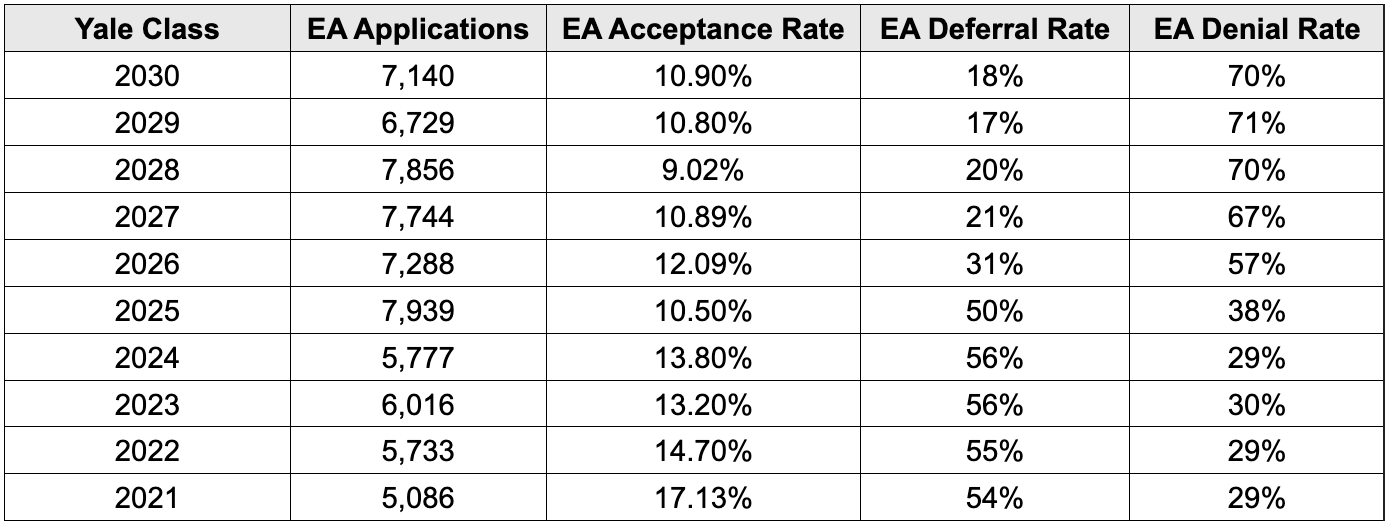
What this shows you:
Application volume rose sharply during the pandemic and then stabilized
Acceptance rates compressed and now fluctuate within a narrow band
Deferrals dropped dramatically and then leveled off
Denials increased and then plateaued
The biggest structural shift has already happened. Yale is no longer experimenting with its early process—it has settled into a clear operating model.
Why the Denial Rate Matters
Seeing a 70% denial rate can feel jarring—but it’s actually one of the most important signals in the data.
A higher denial rate tells you that Yale is choosing clarity over ambiguity. Instead of holding large numbers of applicants in limbo, the admissions office is making firmer early judgments about fit and readiness.
Why does that matter to you?
It means outcomes are more informative
It reduces false hope
It allows students to plan the rest of their application strategy earlier and more effectively
At Ivy Link, we understand how early rounds reward readiness. We guide students—often beginning as early as ninth grade—across the full arc of the admissions process, helping them navigate each stage with clarity, intention, and strategy.
If You Were Deferred
With only about 18% of applicants deferred, a Yale deferral today is both selective and deliberate.
It means your application cleared a serious early cut. The committee saw enough academic strength and alignment to keep you under active consideration — that matters.
At the same time, Yale is deferring fewer students overall, which means the group moving forward is smaller and more tightly defined. There are fewer opportunities for outcomes to change later, and movement in Regular Decision tends to be more limited. That puts the responsibility back on you.
That means:
Updates should be substantive, not cosmetic
Continued academic momentum matters
Your interest should be communicated clearly, specifically, and thoughtfully
If You Were Denied
A denial in Early Action is not a judgment on your intelligence, work ethic, or future success. A denial now often means:
The committee did not see sufficient alignment at this stage
The application did not meet Yale’s threshold for early readiness
It’s time to redirect energy rather than wait
Understanding this distinction matters. It allows you to respond strategically rather than personally—and to invest your effort where it can still have real impact, whether that’s Regular Decision, other highly selective institutions, or strengthening your broader application strategy.
Considering Yale? Get in touch to learn more about Ivy Link’s one-on-one college admissions advising.